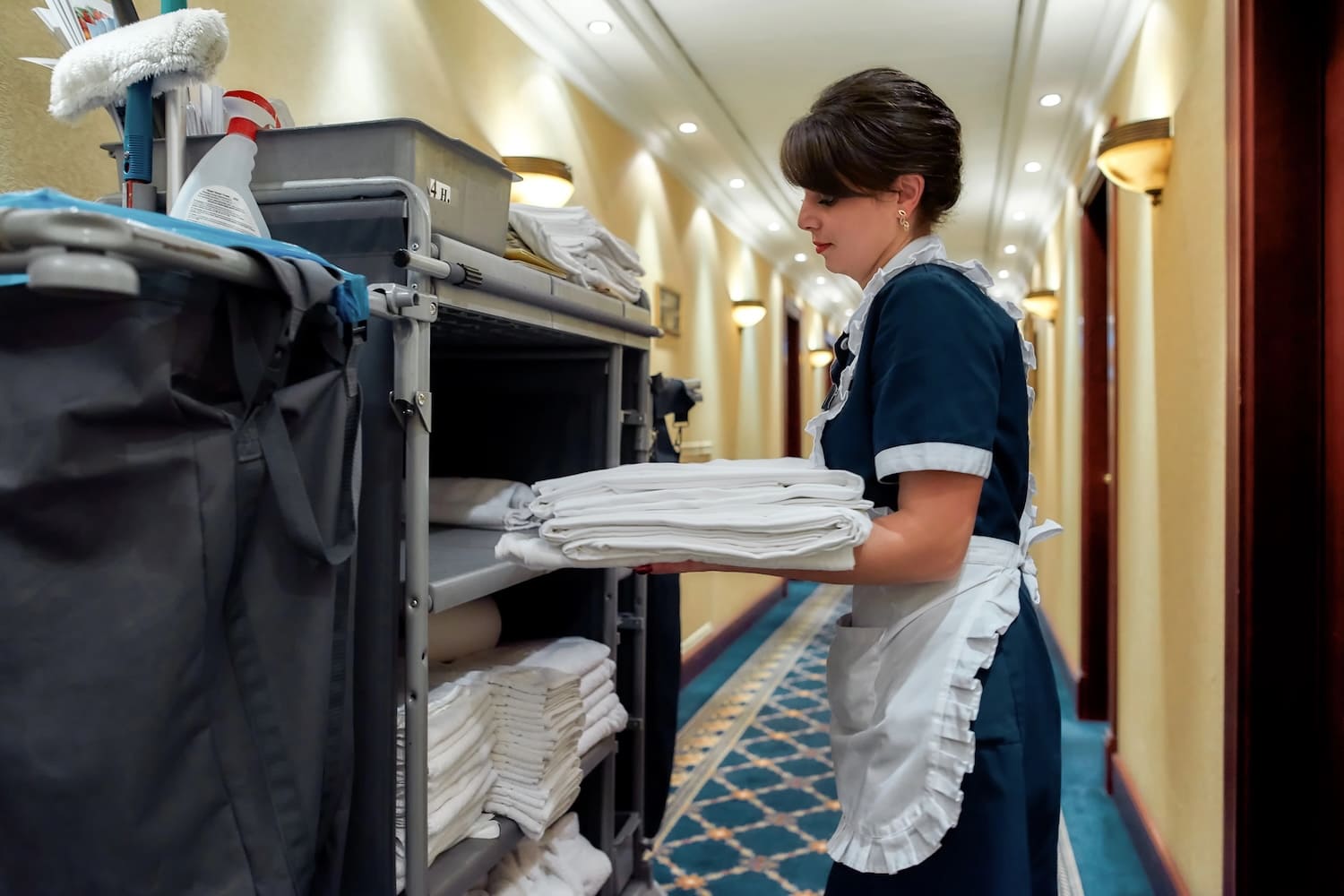
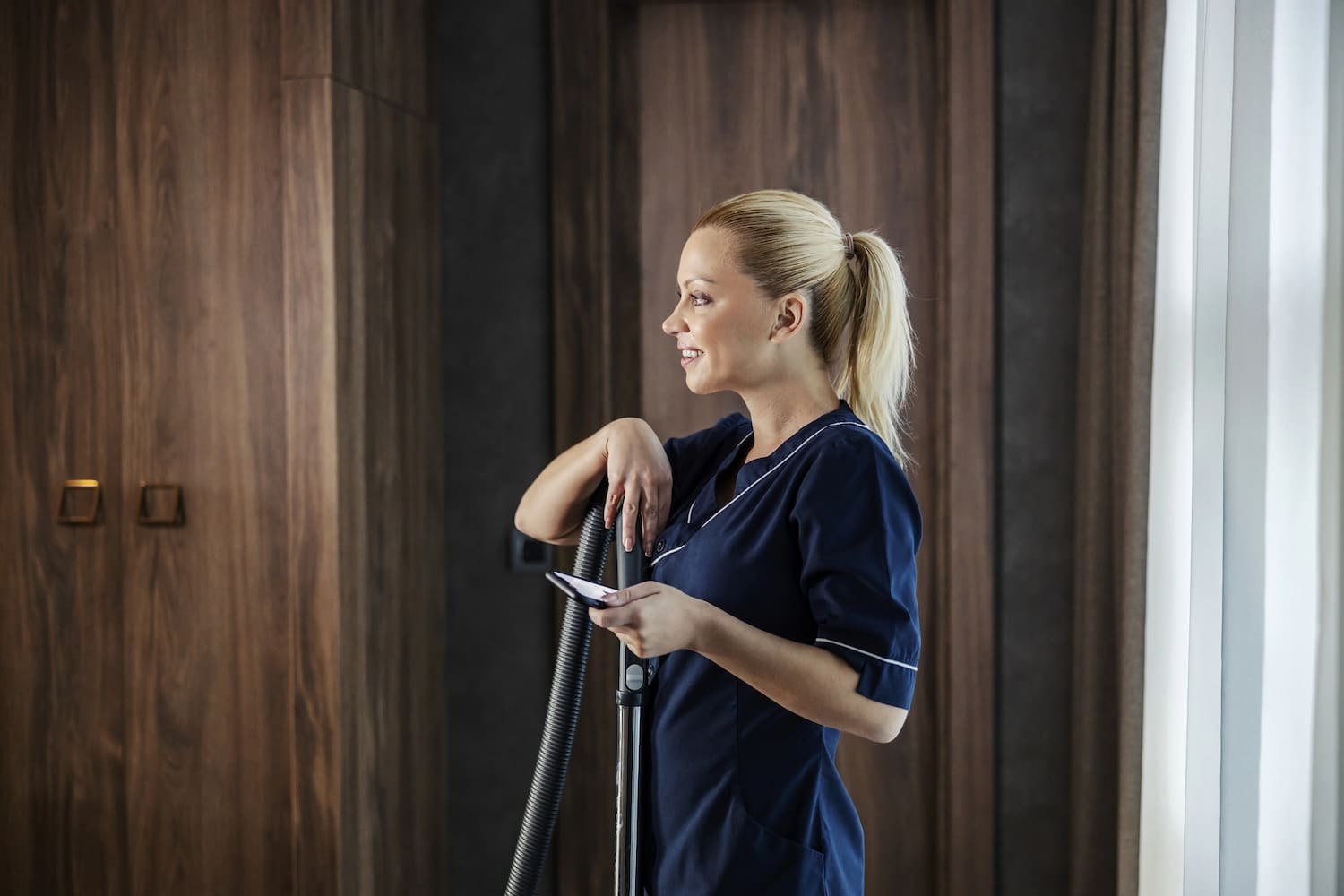
Your housekeeping team doesn’t sit at a desk. They’re scattered across multiple floors, basements, storage areas, and outdoor spaces, and yet they’re expected to respond instantly to maintenance emergencies, coordinate with front desk staff, and keep room statuses current. If you’re still relying on radios that cut out in certain areas or asking housekeeping to walk back to the office to check messages, you’re losing efficiency and creating frustration.
The challenge isn’t that your team isn’t hardworking. It’s that your communication infrastructure wasn’t designed for how housekeeping actually works. They need something that reaches them everywhere on property, integrates with your room and maintenance systems, and doesn’t add complexity to an already demanding job.
The Real Problem with Current Housekeeping Communication
You know the scenario: front desk has a guest complaint about a room issue, but reaching housekeeping takes three phone calls and a walk downstairs. By the time someone shows up, the guest is annoyed, and the housekeeping supervisor is frustrated trying to track down their team. Or worse, a maintenance emergency happens and you’re hoping whoever is closest to that area happened to check their messages.
Many hotels try to solve this with walkie-talkies, but radio coverage in multi-story properties is inconsistent. Basements often have dead zones. Upper floors sometimes miss transmissions. And radios only let you broadcast, they don’t show which staff member acknowledged the message or confirm they actually got there.
How Wireless Handsets Transform Housekeeping Operations
A proper wireless handset system designed for hospitality changes this entirely. Unlike walkie-talkies, modern Digital Enhanced Cordless Telecommunications (DECT) handsets offer:
Reliable coverage across your entire property. DECT technology works differently than traditional radios. It uses multiple base stations positioned strategically throughout your building, so coverage is consistent from the penthouse to the basement storage room.
Direct messaging and prioritisation. When a guest has a maintenance issue, the system doesn’t just broadcast to everyone. Instead, it routes the notification to the closest available housekeeping staff member. If they’re busy, it intelligently escalates to the next person. Your team sees who’s been assigned what, so there’s no confusion about who’s handling which request.
Real-time room status updates. As housekeeping moves through rooms, they update status directly on their handset: room cleaned, inspected, ready. Front desk sees this instantly. No more calling down to ask if a room is ready; they already know. This alone reduces check-in frustration and improves guest experience.
Integration with your Property Management System (PMS). The best wireless systems connect directly to your PMS, so maintenance requests from guests automatically populate on housekeeping devices. A guest calls about a broken air conditioner; it’s already on the system with the room number and guest notes. Your team doesn’t have to wait for someone to manually enter it.
Making It Work Across Multiple Floors and Basements
Coverage in multi-story properties requires smart base station placement. You can’t just install one system and expect it to reach everywhere. Here’s what actually works:
Base station strategy. Position base stations on alternating floors rather than just one per level. A base station on floors 3, 5, 7, and 9 typically covers a 10-story building more reliably than one per floor. Coverage is tested at the initial consultation and also during installation.
Basement coverage. Basements are notoriously difficult for wireless signals, especially if they’re underground or surrounded by concrete. You may need a dedicated base station for basement areas, or at minimum, one positioned near basement entrances. The investment in full basement coverage is worth it, that’s where laundry, storage, and maintenance equipment usually live, and your team needs to stay connected there.
Stairwell and elevator testing. These are dead zones in many properties. Test your system thoroughly in stairwells and elevator shafts before deployment. Some installations require mesh networking (multiple base stations working together) to maintain coverage in these areas.
Outdoor coverage. If your property has courtyards, terraces, or outdoor maintenance areas, extend your coverage there too. Guests notice when housekeeping can’t respond quickly to poolside or patio issues.
Battery Life and Practical Considerations
Wireless handsets are only useful if your team actually has them and keeps them charged. Here’s what you need to plan for:
Battery life versus shift length. Modern DECT handsets last 8–12 hours on a single charge under normal use. But “normal use” for housekeeping is constant talking, messaging, and walking. Your housekeeper isn’t sitting in an office; they’re active all day. Plan for battery life that covers your longest housekeeping shift plus buffer time. If shifts are 8 hours, you want handsets rated for at least 10 hours to avoid someone running out of power mid-shift.
Charging station logistics. Don’t just buy handsets and leave it to chance. Designate a charging station in your housekeeping area where staff charge devices at the start and end of shifts. Make it part of the daily routine, like picking up cleaning supplies. Some properties use a charging dock that holds 6 – 8 devices, which works well for team sizes up to 30 – 40 staff.
Handset durability. Housekeeping handsets take a beating, they get dropped, exposed to moisture, and stuffed in pockets with cleaning supplies. Choose handsets specifically designed for hospitality environments. Mitel’s DECT handsets are built with antimicrobial-treated plastics (BioCote technology) that inhibit bacteria growth, important for devices passed between staff throughout the day. Look for models rated for hospitality durability, not just consumer-grade wireless phones.
Backup plan. Have 1 – 2 spare handsets charged and ready. When a device fails mid-shift, you need a replacement immediately. Your team shouldn’t be without communication because one handset stopped working.
Maintenance Request Coordination That Actually Works
One of the biggest efficiency gains comes from how wireless systems coordinate maintenance requests across housekeeping and maintenance teams. Here’s what’s possible:
A guest reports a plumbing issue. The front desk enters it into your PMS. The system automatically notifies the closest available maintenance staff member via their wireless handset. They acknowledge receipt, investigate, and update status (waiting for parts, assigned to plumber, resolved). Housekeeping sees the update and knows whether to mark the room clean or quarantine it for later.
Everyone sees what the status is. When it’s resolved, the room immediately becomes available for housekeeping to access and prepare for the next guest.
This coordination is only possible if your wireless system integrates with your PMS and uses intelligent notification routing. Basic walkie-talkies can’t do this. You need a Contact Centre AI system which can route priorities intelligently, ensure critical messages don’t get missed, and create audit trails of who handled what and when.
Emergency Notifications and Safety Compliance
Your wireless system is also your emergency communication backbone. When you need to reach all staff instantly, whether it’s a guest safety issue, weather emergency, or evacuation drill, your system needs to deliver that message reliably to everyone, everywhere.
Modern DECT systems broadcast emergency notifications to all devices simultaneously, ensuring no staff member misses critical information. Some systems integrate with your PMS to automatically escalate emergency alerts and log them for compliance documentation.
This is particularly important for multi-story properties. You can’t assume people heard a general announcement; you need confirmation that each staff member received and acknowledged the emergency message.
Measuring Impact on Housekeeping Efficiency
Before you implement a new system, know what you’re trying to improve. Good metrics include:
- Room turnover time (how long from checkout to room ready for next guest)
- Maintenance request response time (from report to staff arrival)
- Staff utilisation (percentage of shift spent on actual cleaning versus searching for information or waiting for messages)
- Guest complaints related to room readiness or maintenance delays
- Adoption rate (percentage of housekeeping staff actively using handsets)
A new wireless communication system won’t fix poor housekeeping management or chronic staffing shortages. It’s not a silver bullet. But for properties with reliable staff who need better tools to coordinate, it’s transformative. It removes friction from their day, improves guest experience, and gives management real visibility into what’s happening across the property in real time.
The return comes from efficiency gains, fewer guest complaints about delays, and staff satisfaction knowing they have the tools to do their job well.
Ready to learn more about mobility for your property? Reach out to our team today.